


This post collects a thread I posted on X, written in reply to Xinyu Yang’s point about inference cost in our paper on latent feedback [1]
Latent Feedback Is a Compute and Data Amplifier
B. Huang, C. Dwivedi, X. Ma, A. Moreno, H. Liu, (2026)
arXiv:2611.20404
.

A free lunch from the loop’s topology
Latent feedback [1,2]
Latent Feedback Is a Compute and Data Amplifier
B. Huang, C. Dwivedi, X. Ma, A. Moreno, H. Liu, (2026)
arXiv:2611.20404Full-bandwidth Transformer
X. Wang, Z. Cai, Z. Zhan, H. Dong, Y. Fan, G. de Rosa, T. Pearce, J. Langford, (2026)
arXiv:2608.08888
is known to cost extra prefill FLOPs (floating-point operations). One workaround is to add a loss on a no-feedback pass, but that adds FLOPs during training. Finding the sweet spot needs scaling-law experiments.
By contrast, we can change where the loop reads and writes. A shorter loop re-runs fewer blocks, so prompts naturally cost fewer FLOPs, and it can perform even better than the top-to-bottom loop and the baseline Transformer with the same prefilling FLOPs.
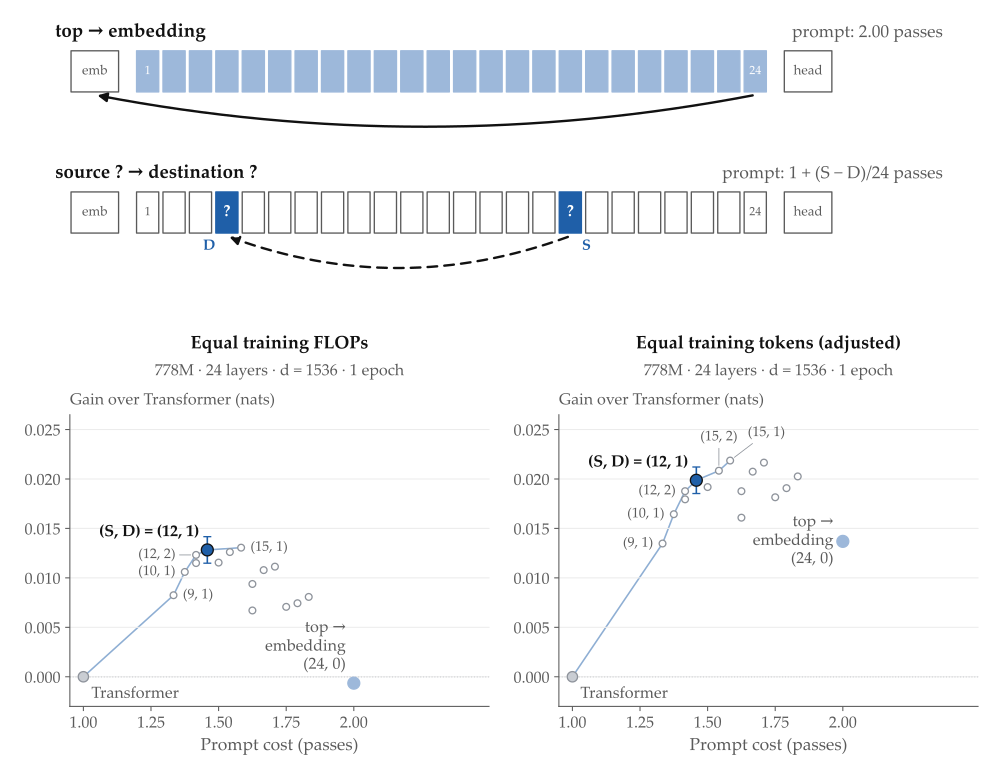
Top: the top → embedding loop re-runs all 24 blocks, so a prompt costs 2 passes; a loop from source block S to destination block D costs \( 1 + (S - D)/24 \). Bottom: gain over a tuned Transformer against prompt cost for every span (S, D) at 778M, 1 epoch, at equal training FLOPs (left) and equal training tokens (right).
How bad is a 1-pass prompt for a top-to-bottom feedback model?
With a 1-pass prompt, the top → embedding loop loses ~60% of its gain across the next 1,024 tokens (134M).
The drop fades at later positions. But this is teacher-forced loss on held-out text, not generation. The healing may not hold :-(
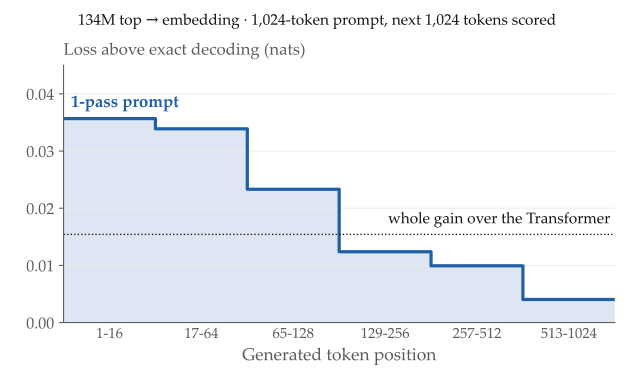
134M top → embedding, 1,024-token prompt, next 1,024 tokens scored: extra loss of a 1-pass prompt over exact decoding by token position. The dotted line is the model’s whole gain over the Transformer on the same tokens.
Where should the loop sit?
It depends on what is held fixed: about mid-depth at equal FLOPs, or the upper half at equal tokens, in line with Xiong, Chen & Chen [3,4]
Don’t Feed Back the Last Block
X. Xiong, S. Chen, M. Chen, (2026)Attention Latent Feedback
X. Xiong, S. Chen, M. Chen, Y. Su, Z. Yang, P. Luo, X. Liu, (2026)
arXiv:2611.31154
.

We swept source × destination from scratch for 134M and 778M models, with tuned baselines and 3 seeds for the leaders.
Every run matches the Transformer’s training FLOPs on one pool of 50 unique tokens per parameter: 4 epochs at 134M, 1 epoch at 778M.
Feedback costs more per step, so at equal FLOPs its runs see fewer tokens: 3.3–3.8 epochs at 134M, 0.79–0.92 at 778M.
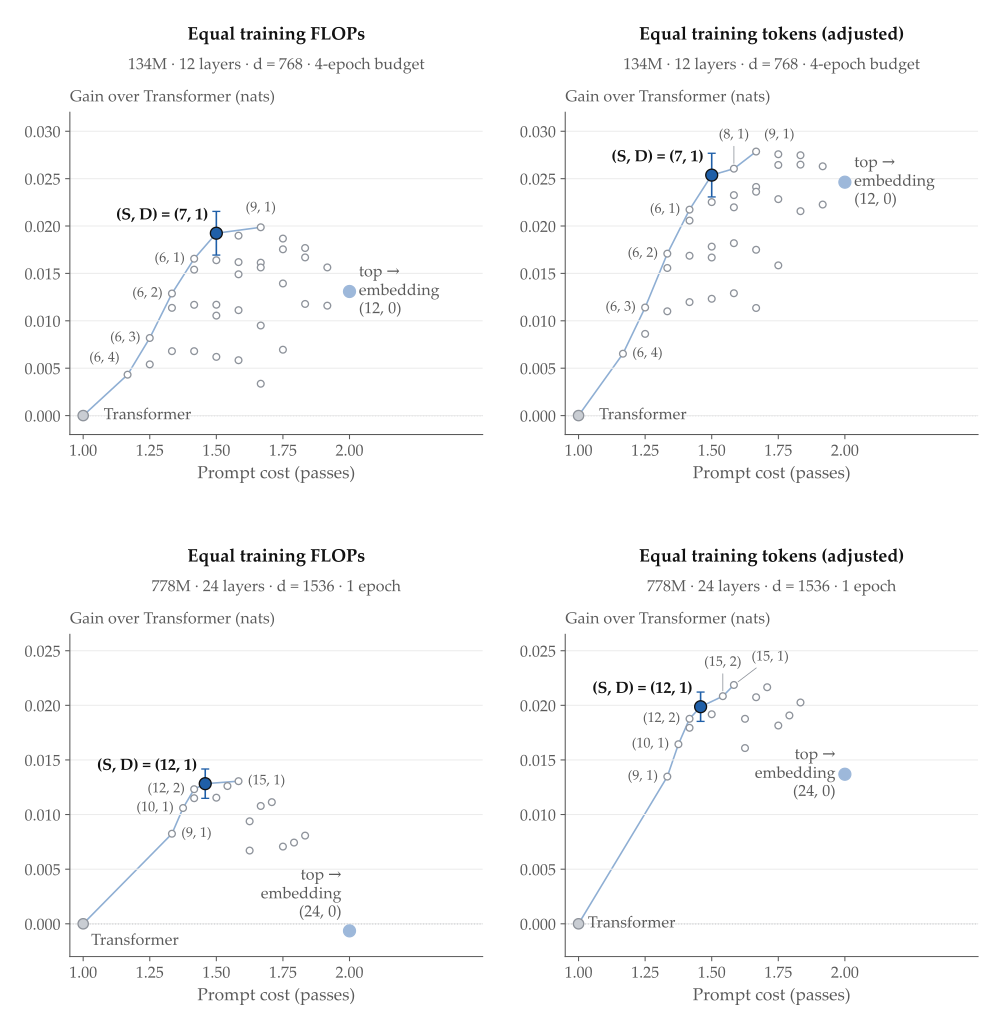
Gain over a tuned Transformer against prompt cost for every span (S, D): block S feeds block D on the next pass, and D = 0 is the embedding. Rows: 134M (12 blocks) at a 4-epoch budget and 778M (24 blocks) at 1 epoch. Columns: equal training FLOPs and equal training tokens.
Does this topology change help a 1-pass prompt?
Amazingly, yes. By changing the source and destination, a 1-pass prompt loses less of its gain (left) and performs better than top → embedding with a 1-pass prompt at every budget (right).
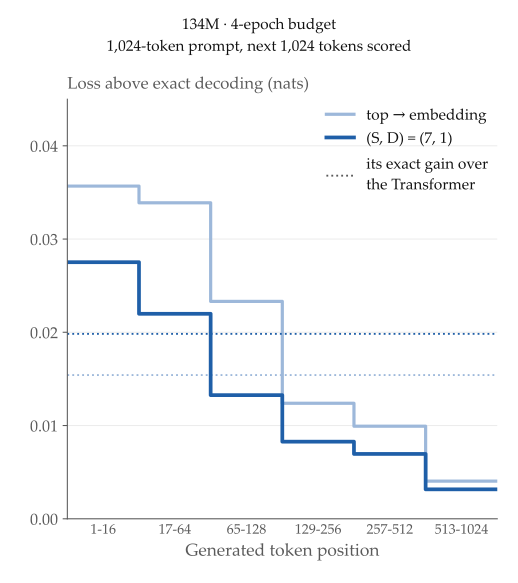
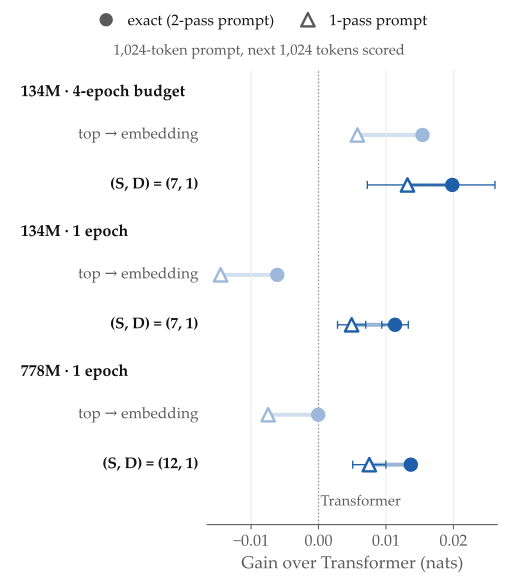
Left: extra loss of a 1-pass prompt by token position at 134M, 4-epoch budget, for top → embedding and (S, D) = (7, 1); dotted lines mark each model's exact gain over the Transformer. Right: gain over a tuned Transformer with an exact (2-pass) and a 1-pass prompt, top → embedding against (S, D) = (7, 1) at 134M and (12, 1) at 778M. Both on the 1,024 tokens after a 1,024-token prompt.
However, as the left panel shows, for short generations it still does not beat a Transformer at equal prefill FLOPs. And this is teacher-forced, not real autoregressive generation, where errors may compound further. That said, it still beats top-to-bottom!
Discussion on X

References
- [1]Latent Feedback Is a Compute and Data Amplifier
B. Huang, C. Dwivedi, X. Ma, A. Moreno, H. Liu, (2026)
arXiv:2611.20404 - [2]Full-bandwidth Transformer
X. Wang, Z. Cai, Z. Zhan, H. Dong, Y. Fan, G. de Rosa, T. Pearce, J. Langford, (2026)
arXiv:2608.08888 - [3]Don’t Feed Back the Last Block
X. Xiong, S. Chen, M. Chen, (2026) - [4]Attention Latent Feedback
X. Xiong, S. Chen, M. Chen, Y. Su, Z. Yang, P. Luo, X. Liu, (2026)
arXiv:2611.31154
Cited as
Use the plain citation or copy the BibTeX entry below.
Benhao Huang. (Nov 2026). Correct Loop Topology Brings a Free Lunch for Latent Feedback Models. Husky's Log. https://huskydoge.github.io/husky-blog/posts/recursive_models/loop-topology/
@article{huang2026correct,
  title   = "Correct Loop Topology Brings a Free Lunch for Latent Feedback Models",
  author  = "Benhao Huang",
  journal = "Husky's Log",
  year    = "2026",
  month   = "Nov",
  url     = "https://huskydoge.github.io/husky-blog/posts/recursive_models/loop-topology/"
}